
Currently Empty: £0.00

the Royal Tank Regiment
- Home
- the Royal Tank Regiment
HAVOC Watches are proud to be associated with the Royal Tank Regiment – one of the most historic and highly respected battalions in the British Army. With a legacy spanning more than a century, the Regiment has played a defining role in the development of armoured warfare and continues to represent the evolution of military capability. Their story is one of adaptation, professionalism and service shaped by generations of soldiers who have operated in some of the most demanding environments in warfare.
The Royal Tank Regiment is the oldest tank unit in the world – established in 1916 during the First World War as part of the Heavy Section of the Machine Gun Corps. It was formed in direct response to the deadlock of trench warfare, when early armoured vehicles were introduced as a new attempt to break static lines on the Western Front. What began as an experiment quickly proved its value and laid the foundations for what would become a permanent armoured force.
Since then, the Regiment has developed alongside the changing nature of armoured warfare. From the first improvised tanks of the Great War to the formidable world-class Challenger 2 tanks in service today, it has remained an operational armoured unit, adapting to shifts in technology, doctrine, and battlefield requirements.
At its core, the Regiment is defined by its people. Its history is marked by service in major conflicts across the globe, including the First and Second World Wars, campaigns in North Africa, and more recent operations in Iraq and Afghanistan. While the nature of warfare has changed dramatically over time, the standards expected of Royal Tank Regiment soldiers have remained constant. Courage, discipline and cohesion are central to its identity – forming the foundation on which operational effectiveness is built.
Alongside its operational functions, the Royal Tank Regiment maintains established traditions and commemorative practices that reflect its history and those who have served it. These customs sit alongside ongoing adaptation and modernisation, linking past and present while ensuring the Regiment continues to evolve to meet the requirements of contemporary military service.
The Battle of Cambrai
The Battle of Cambrai, fought in November–December 1917, marked a turning point in the First World War through the first large-scale, coordinated use of tanks in combat. While earlier deployments of tanks had been experimental and often mechanically unreliable, Cambrai demonstrated that armoured vehicles, when used in concentration and supported properly, could break entrenched defensive systems that had previously seemed impenetrable.
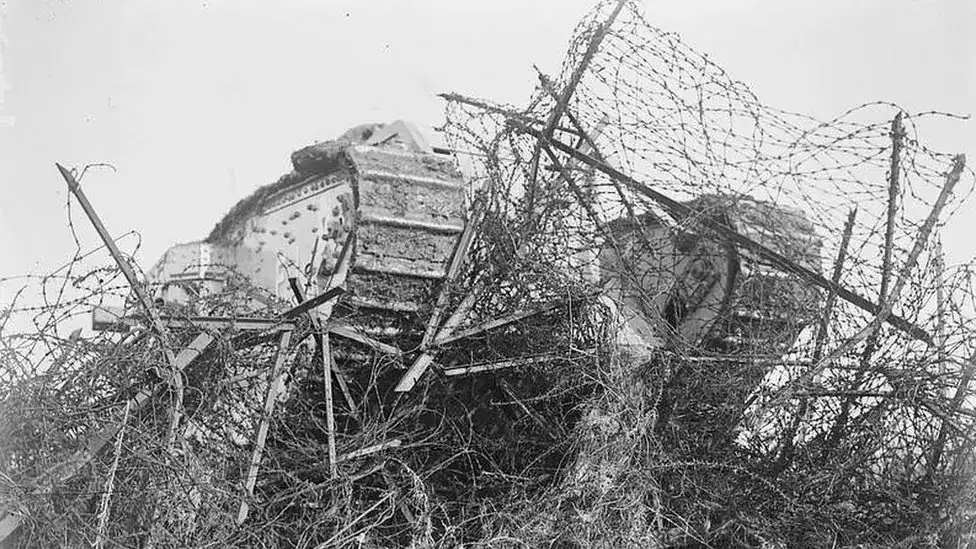
On 20 November 1917, British forces launched a surprise offensive against German positions near the town of Cambrai in northern France. Unlike previous offensives on the Western Front, there was no prolonged artillery bombardment beforehand. Instead, the British relied on secrecy and the shock effect of armour. Around 476 tanks were committed to the initial assault, supported by infantry and aircraft – the first time tanks were used en masse in a coordinated operational plan.
The initial breakthrough was striking. The tanks were able to crush barbed wire, cross trenches and suppress machine-gun positions, allowing British infantry to advance several miles in a matter of hours. This was a significant contrast to the stagnation that had defined much of the Western Front, where progress had been around 3 or 4 miles a year. The success at Cambrai demonstrated the potential of combining armour with artillery fire-for-effect, infantry movement, and air reconnaissance – an early example of what would later be recognised as combined arms warfare.
However, the breakthrough was not fully exploited. Logistical limitations, mechanical breakdowns, and exhaustion among advancing units slowed the British advance. Crucially, there was also a lack of effective reserves to hold captured ground. Within days, German forces regrouped and launched a determined counterattack and by early December, much of the ground gained in the initial assault had been recaptured, resulting in a strategically inconclusive outcome.
But despite the lack of a decisive territorial victory, by demonstrating what tanks could achieve under the right conditions, Cambrai marked a dramatic shift in British military strategy. For the first time, armoured warfare proved capable of delivering a rapid breakthrough against entrenched positions. The psychological impact was also considerable: German troops, previously confident in the invulnerability of trench systems, were forced to confront a new kind of battlefield threat.
The battle’s influence extended well beyond 1917 – British and German forces both began to adapt their tactics. The Germans accelerated development of anti-tank weapons and more flexible defensive systems, while the British refined armoured doctrine, emphasising coordination between tanks, infantry, artillery and air power. Although tanks at Cambrai were still mechanically fragile and tactically experimental, the lessons learned directly informed later operations in 1918, where armoured formations played a decisive role in breaking the stalemate of the Western Front.
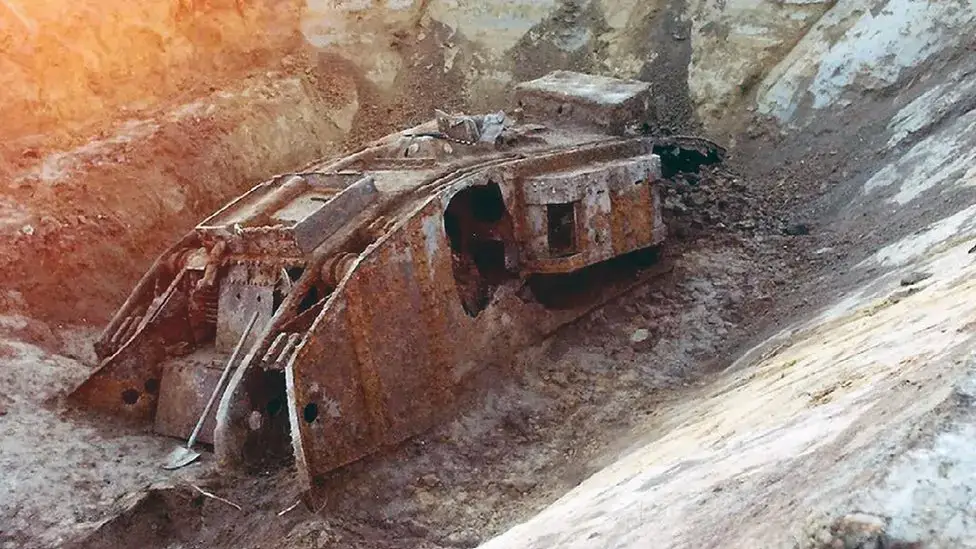
While the First World War would not be decided by tanks alone, Cambrai ensured that armoured warfare would become a permanent and evolving feature of military doctrine in the decades that followed.
Accusing as I do without exception all the great Allied offensives of 1915, 1916, and 1917 as needless and wrongly conceived operations of infinite cost, I am bound to reply to the question, “What else could have been done?” And I answer it, pointing to the Battle of Cambrai: “This could have been done.”
Winston Churchill
Accusing as I do without exception all the great Allied offensives of 1915, 1916, and 1917 as needless and wrongly conceived operations of infinite cost, I am bound to reply to the question, “What else could have been done?” And I answer it, pointing to the Battle of Cambrai: “This could have been done.”
Winston Churchill
From mud, through blood, to the green fields beyond.
The modern Royal Tank Regiment remains one of the most distinctive units in the British Army, from its origins in the Great War it has developed into a permanent armoured formation within the Royal Armoured Corps, providing the British Army’s specialist heavy armour capability.
At its core, the Regiment operates as Britain’s main tank unit. It is currently equipped with Challenger 2 main battle tanks, 62-tonne platforms armed with 120mm rifled guns and designed for protected firepower and cross-country mobility. Crews are trained to operate in high-intensity combat conditions as part of combined arms formations, where tanks work alongside infantry, artillery, engineers and reconnaissance elements. Training focuses on live firing on ranges such as Lulworth and Castlemartin, manoeuvre warfare, and operating within NATO command structures that require rapid integration with multinational units.
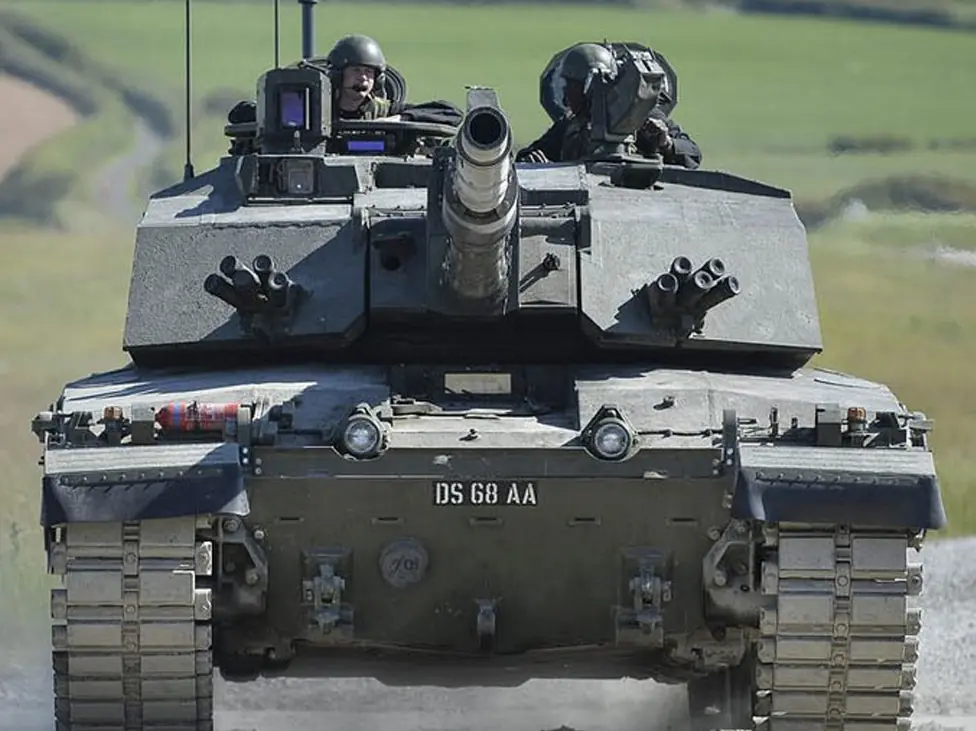
A Challenger 2 is crewed by four soldiers – commander, gunner, loader and driver – and effectiveness depends on coordination within the crew as well as between vehicles. Troops operate in squadrons made up of multiple tanks typically grouped into sabre squadrons and supported by HQ elements. The Regiment is structured to deploy at squadron or battle group level depending on tasking, with integration into larger armoured brigades when required.
Today’s RTR regularly participates in large-scale training exercises in the UK and Europe, including NATO exercises such as those conducted in Poland, Estonia and Germany. These exercises test interoperability between allied armoured and mechanised forces, including shared command systems such as the NATO communications architecture, logistics under deployed conditions, and the ability to operate in dispersed, multi-domain environments.
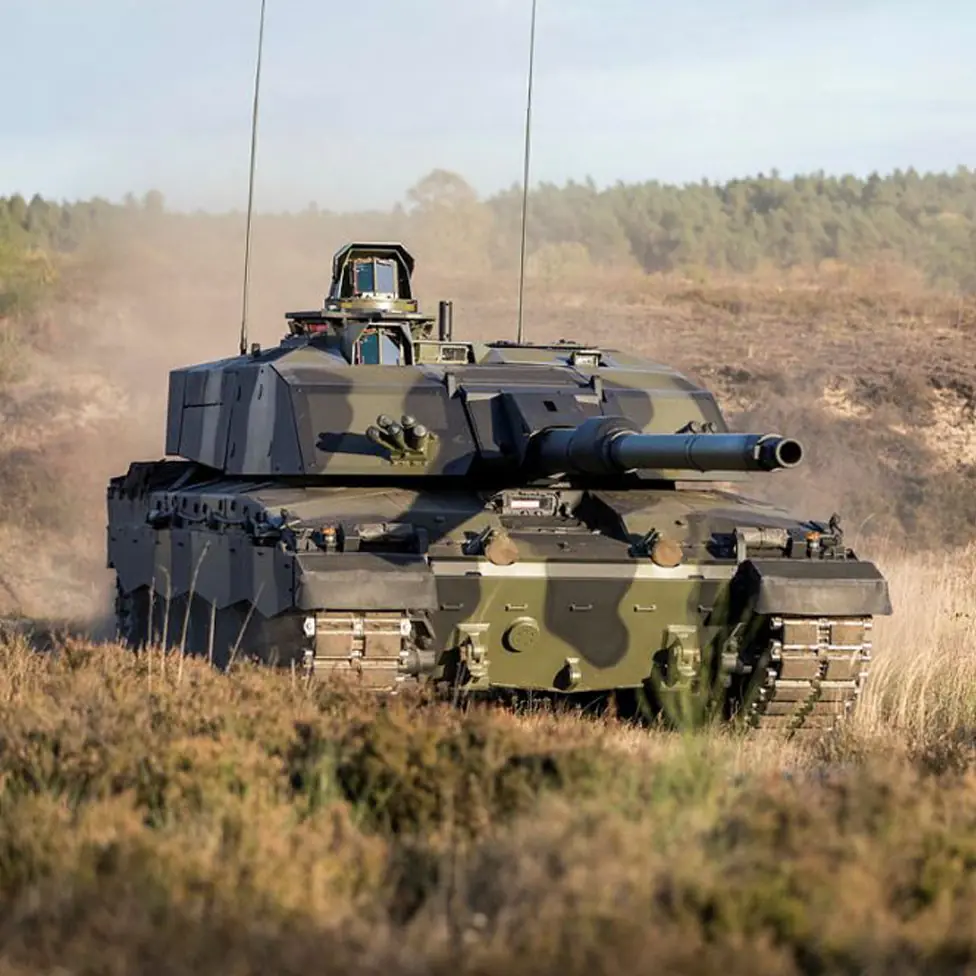
The Regiment also contributes to the British Army’s armoured readiness cycles, where squadrons rotate through high-readiness states for potential rapid deployment.
Alongside its tank squadrons, the Regiment includes reconnaissance and support elements that contribute to battlefield awareness and force protection. These capabilities include forward reconnaissance patrols, surveillance integration, and coordination with unmanned aerial systems used at brigade level. This supports armoured manoeuvres by providing intelligence on terrain, enemy positions, and movement corridors, allowing tanks to operate with greater tactical awareness and reduced exposure. While the image of the tank often dominates public perception, the reality is a far more nuanced system of capabilities working together.
Across the Regiment, training is continuous and highly structured. Crews rotate through driver training, gunnery qualifications, tactical exercises, and combined arms battle group training. Exercises often culminate in force-on-force scenarios at brigade level, where armoured units are tested in offensive and defensive operations under realistic battlefield conditions.
What makes the Royal Tank Regiment compelling today is their balance between permanence and change. The machines have evolved beyond recognition, the doctrine has been refined, and the operational environment has shifted repeatedly but the essential purpose remains – they are masters of mounted close combat, fusing mobility and firepower to shatter the will and cohesion of the foe.
The Royal Tank Regiment Association is comprised of serving and former officers and soldiers of the Royal Tank Regiment and its antecedent regiments. Membership is automatic upon leaving the Regiment, ensuring that no one who has served is ever disconnected from the wider RTR family.
The Association provides a lasting link between past and present, supporting welfare, remembrance, and regimental events while keeping the spirit and traditions of the Regiment alive long after active service has ended.
In partnership with the Association, HAVOC Watches are proud to offer the HAVOC 1917 – a timepiece which reflects our shared emphasis on precision, reliability and performance under pressure. Emblazoned with an iconic Challenger 2 tank and featuring the exclusive Regimental green, red and brown colours, representing their 1917 battlefield cry: from mud, through blood, to the green fields beyond.